How People Can Be Rational Despite Being Fallible
A Fallibilist View of Reason

While perusing X, I came across a post (pictured below) by Aella on rationality and our lack of understanding of it. Aella is associated with the rationalist community, a loose group of people interested in understanding the world through reason, science, and critical thinking. The post argues that there is a disconnect between being smart and being rational, the latter being the more important of the two, and that since we reward cleverness, we consequently tend to allocate power and decision-making to people for the wrong reasons.
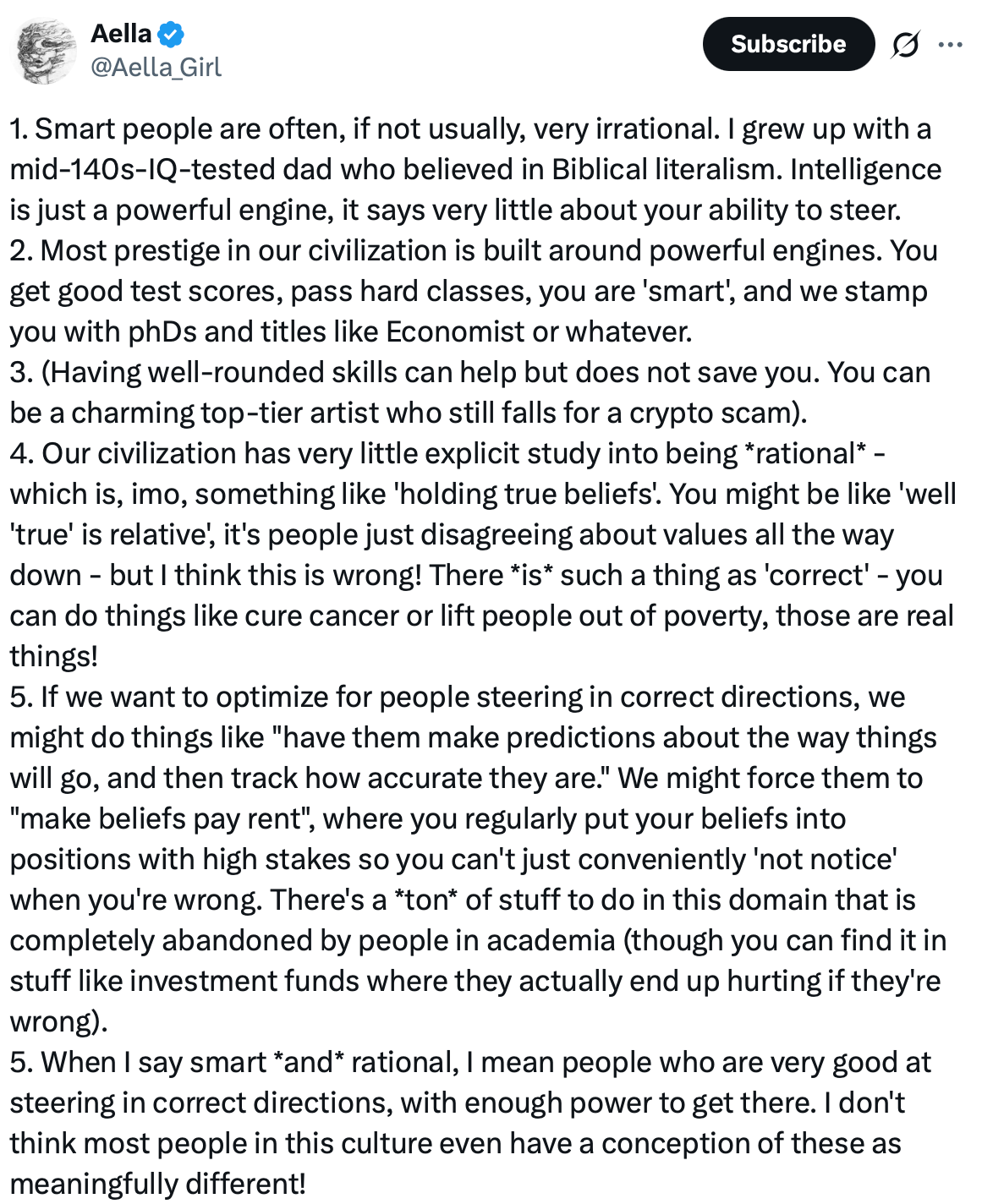
This way of thinking about rationality is not unique to Aella. Variants of it are common in the rationalist community, which often treats rationality as a matter of making accurate predictions, holding true beliefs, or updating correctly in light of evidence.
I’m sympathetic to the view expressed in the post, not least because I agree with the core argument that rationality is poorly understood despite its importance. The community of rationalists are often unusually interested in understanding the world and correcting mistakes. Yet I think the underlying picture remains somewhat too mechanistic. It focuses on the outputs of inquiry (predictions, forecasts, and beliefs) rather than on the creative and critical process by which explanations are generated and improved.
Hence, there are some errors in the post that are worth addressing. The one that stands out most is the idea that rationality is “holding true beliefs”. The problem is that we rarely know which of our beliefs are true.
Consider Newton’s theory of gravity. We now know it is false because some of its assumptions are incompatible with experimental results. Was Newton, therefore, irrational for proposing and advocating this false idea? Likewise, some of our current best theories must be false. Quantum theory and general relativity, for example, cannot both be true in their present forms, since they make incompatible claims about the world. So, although science seems to be the pinnacle of rationality, are scientists irrational to hold and use both theories?
The problem is with the idea that rationality consists of holding true beliefs. We do not know which of our theories is true. Indeed, critical examination often reveals that theories we once thought true are false or incomplete. What, then, does rationality consist of if not being in possession of the truth?
Popper’s philosophy points in a different direction. The central feature of science is criticism. Scientific knowledge grows because theories are subjected to criticism, problems are identified, and new explanations are created to solve them. Consequently, rationality is not a state of being or of holding the right ideas; it is a process. We search for errors in existing theories and then attempt to solve those errors through the creation of better theories.
Science is perhaps the clearest example of such a process. Newton attempted to explain the behaviour of the stars and planets. Earlier theories could often describe these motions without providing a mechanism for why planets should behave in such a way. Why do planets orbit the sun at all? That was not a question Kepler and his contemporaries could answer, despite their brilliance and their advances in describing planetary motion. Newton explained planetary motion in terms of a deeper principle, namely gravity, which also explained the behaviour of ordinary objects on Earth. In this way, he solved problems that previous theories could not.
Science is not the only example of rational inquiry, however. Rationality is ubiquitous in the modern world. My favourite example from outside science is markets, which exemplify rationality: people (businessmen, engineers, software developers and so forth) search for problems with existing products and services and solve them for a profit.
Consider the invention of the first iPhone, and in particular its touchscreen. Previous phones were constrained by a fixed user interface (UI) provided by a keyboard, yet applications and new software required more flexibility from the UI than the keyboard could provide. A touchscreen allows the UI to be rearranged across apps, relieving both users and software developers of the constraints of the physical keyboard (as Jobs discussed in this talk). Existing ideas about phone design were criticised, a problem was identified, and a new solution was proposed.
Similarly, as a Dyson fan, I was pleased to find that their slogan is ‘we solve the problems others ignore’ (see, for instance, this video). Both these examples demonstrate rationality in Popper’s sense.
So rationality consists of searching for errors in existing ideas and eliminating them through creatively proposing new ones. Rationality is fundamentally a process, but we call people rational when they habitually participate in that process.
One immediate consequence is that rationality may be highly specific. People are specialised, and someone may be rational in, for example, physics but not in their private life. Einstein was a great physicist but, by most accounts, not a great father (see Walter Isaacson’s biography), so he may be said to have been rational in one aspect of his life and not in another.
This is one of the problems that also exists with the label “smart”, which, as Aella points out, is somewhat misleading. Smartness is an umbrella term that describes many different abilities: memory, mathematical aptitude, performance on exams, rhetorical skill, and so on. None of these obviously align with rationality in a particular domain, yet the two are often conflated.
This is something I’ve noticed in academia as well, where people who perform well on exams and are therefore labelled “smart enough to pursue a PhD” are not necessarily the people who produce the most interesting articles. That same disconnect is less prevalent in the private sector. The private sector has its own inefficiencies, but it often rewards people who are able to identify and solve problems, as that is what earns money.
Rationality is not a matter of possessing truth. It is a process of identifying problems, criticising existing ideas, and creatively constructing better ones. This basic programme is remarkably universal. It can be applied to science, philosophy, politics, engineering, business, and private life. Historically, something like this attitude became increasingly prominent during the Reformation and later in the Anglo-Dutch Enlightenment, when people began to criticise long-standing beliefs (especially religious ones) rather than accepting them on the authority of others.
Since then, this critical attitude has spread into many domains. Scientists criticise theories. Entrepreneurs criticise products. Philosophers criticise arguments. Individuals criticise their own decisions and habits.
This, I think, is where the mechanistic picture of rationality goes wrong. Rationality is not primarily about holding the right beliefs or making the right predictions. Those things may happen as a consequence of rational inquiry, but they are not what make it rational. Rationality is the process of creating explanations, exposing them to criticism, and improving them when problems are found. Knowledge grows not because we possess truth, but because we are able to find and correct errors.
The American Bill Bartley took up Popper's ideas on rationality with both hands and made it into a major project. He fell out with Popper for 12 years until they reconciled, and Bartley edited the 3 volumes of the Postscript to the Logic of Scientific Discovery. Tragically, he died in his prime, aged 55, in 1990. He was working on Popper's biography and also a biography of Hayek.
I have written a great deal about Popper and related matters over the years.
http://www.the-rathouse.com/writingsonpopper.html
http://www.the-rathouse.com/writingsonbartley.html
https://www.amazon.com.au/s?k=Rafe+Champion&i=stripbooks&crid=GZ66NWUYZ193&sprefix=rafe+champion%2Cstripbooks%2C262&ref=nb_sb_noss
It is great to find your site!
Interesting thoughts. However, strictly speaking markets do not exemplify rationality in the sense you are talking about. Rationality is the use of your mind as a means to achieve knowledge. And it is the attribute of the individual, while a "market" is the collection of trading individuals (some can choose to be irrational).
And as you said "Rationality is not a matter of possessing truth" it is the tool which allows you to seek and find the truth. High IQ doesn't mean rationality. Many good scientists, for example, are very religious. And belief is not knowledge (belief is based on mysticism, knowledge on reality) but they compartimentalise the two things allowing themselves to hold the contradiction in their mind.